
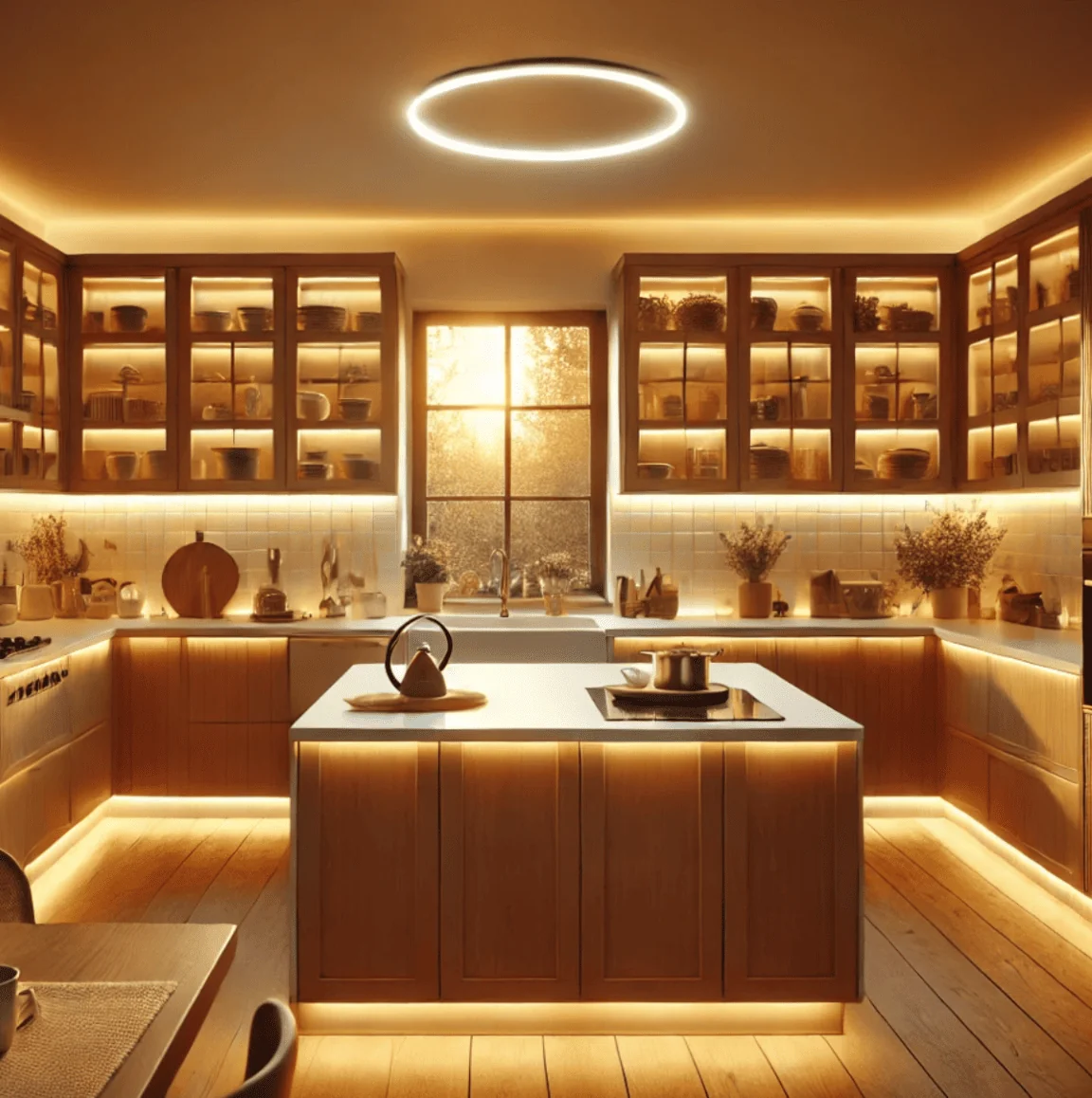
Home renovations are one of the best ways to bring your home to your liking, down to the smallest detail. Spaces such as bathrooms and kitchens can be completely changed only with details such as decoration or lighting, it is not necessary to make abrupt changes.
In fact, lighting is one of the most important and sometimes forgotten parts of the decoration and renovation of spaces.
In today’s article, we give you all the keys to learn how to illuminate a kitchen, so you can apply it in yours and with the best ideas to distribute the points of light, choose the most appropriate systems and make the most of the most innovative lighting.
How to plan the lighting in a kitchen
Before we start explaining how to light a kitchen, it’s a good idea to do a little planning. Keep these aspects in mind:
- What you use your kitchen for: cooking every day is not the same as using it only occasionally. The more functional it is, the more focal and practical light you will need.
- Space distribution: do you have an island, a dining area, windows? Natural light also influences how to illuminate a kitchen.
- Decorative style: rustic, modern, minimalist, japandi… The lighting must fit with the general aesthetics, both in form and color temperature.
The key areas
A well-lit kitchen does not depend on a single lamp. It is a matter of combining several types of light depending on the areas and the use you make of them. Here are the basic areas that you should illuminate:
Work area
This is where you need precision the most. Use direct, focal light, preferably white or neutral, that does not cast shadows. Strip lights under tall furniture or recessed LED spotlights are ideal for these areas.
Illuminates storage spaces
It is not essential, but having light in these spaces is very convenient. There are sensor lights that turn on when you open the door. You can also use an energy-saving LED strip light.
Dining area or central island
If you have an island or a dining area, the lighting should be softer and warmer to create a cozy atmosphere. A pendant lamp is a good choice if the space allows it. In addition, with our Gola profile you can gain a subtle light that will allow you to play with a minimalist style in those drawers without handles.
General ceiling illumination
The basis of everything. If you are wondering how to illuminate a kitchen with a more interesting solution than the most typical lights, you can opt for LED spotlights or our subtle LED profiles. Avoid very cold bulbs that “cool” the environment. A very elegant solution.
Ambient or decorative lighting
For a touch of style, you can use aluminum profiles for LED strips with decorative lights. For example, dimmable LED strips on tall furniture or skirting boards. They add depth and elegance without cluttering.
Recommended light types for each zone
How to illuminate a kitchen is also about knowing what color temperature you want for each space. The key is to combine well:
- Cold light (5000k – 6000K): useful in working areas because it improves visibility. Not recommended as main light if you want a cozy kitchen.
- Neutral light (4000 K): ideal for almost everything. It is functional but pleasant, and does not distort colors.
Warm light (2700k – 3000K): perfect for creating ambiance. Use it in dining areas or decorative lighting. An example of this is our dual LED, with a system that converges all temperatures and by means of a remote control you can regulate the color and intensity. Adapting to the different times of the day, a cooler light for more precise tasks and a warm light for more relaxed moments.
How to light a small kitchen to make it look bigger
Good lighting can work miracles in small kitchens. With these tricks, knowing how to light a small kitchen will be a piece of cake.
- Light colors and light-reflecting surfaces: whites and pastel shades help light to be better distributed.
- Avoid a single central light source: several small distributed spots are better.
- Light under tall furniture: creates a feeling of spaciousness and eliminates shadows.
- Illuminate the corners well: do not leave dark areas that give a feeling of narrowness.
How to combine natural and artificial lighting
We have already talked about how to illuminate a kitchen with artificial light, but do not forget that natural light is your best ally. But you have to know how to use it well and complement it:
- Don’t block the windows: use light curtains or blinds that let the light in.
- Place the light points according to the orientation: do not place very powerful lights near windows, or you will generate contrast and shadows.
- Avoid glare: if you have shiny countertops, adjust the angle of the bulbs or choose bulbs with diffusers.
Style and design: How to use light to give personality to your kitchen
Lighting not only serves to see better: it is also part of the style. Here are some ideas to give character to your kitchen:
- Pendant lamps over the island or bar: combine functionality and design. Look for models that contrast or harmonize with the furniture.
- Indirect light in high areas: it gives depth and a very elegant touch.
- Decorative lights with personality: exposed bulbs, vintage sconces or colored LED light in specific details.
Maintenance and durability tips for LED systems
How to illuminate a kitchen is not only about knowing how to put lights in the spaces, but also how to take care of them, to keep them in good condition as long as possible.
- Clean diffusers and luminaires regularly to avoid losing light output.
- Avoid electrical overloads with good quality materials.
- Replace LED bulbs when you notice flickering or loss of intensity, even if they last for many years.
- Always use suitable transformers or drivers in more complex systems.
Recommended products for every need
In the SC Herrajes catalog you will find options for all types of kitchens. Some useful recommendations:
- Self-adhesive LED strips to illuminate countertops.
- Recessed adjustable spotlights for work areas.
- LED strips with sensor for inside cabinets or drawers.
- Dimmable lighting kits to adjust the light according to the time of day.
Lighting well is cooking and living better
Knowing how to light a kitchen is much more than just putting a nice lamp. It’s about planning well, thinking about the real use you make of the space and choosing efficient solutions that help you gain comfort, style and visual amplitude.
With good lighting, your kitchen will not only be more functional, but also more welcoming. And if you want more ideas about decoration, hardware, lighting and much more, don’t forget to visit our blog.